Polymarket Signals: Why Ceasefire Odds Surged from 10% to 56% on $160K Whale Bets
Analyze the latest Polymarket signals behind the ceasefire odds spike from 10% to 56% after massive whale buys. Key prediction market insights, odds changes, and trading strategies for March 2026 events.
Polymarket Signals: Why Ceasefire Odds Surged from 10% to 56% on $160K Whale Bets
Polymarket signals exploded into headlines. Ceasefire odds rocketed from 10% to 56% after a $160K whale bet. This dramatic shift shows the raw power of prediction markets. But what does it mean for traders?
Stick with me. Break down this Polymarket analysis, and you'll see how whale bets drive odds changes, decode the events behind the ceasefire surge, spot key prediction market signals, and pick up strategies to read trends and capitalize on future moves like a pro.
What Is Polymarket and How Do Prediction Markets Work?
Picture this: you're betting on whether a ceasefire happens in some hot conflict zone, not with a shady bookie, but on a blockchain platform where everyone watches every move. That's Polymarket. A decentralized prediction market built on Polygon, using USDC stablecoin for trades. No middleman. Just you, crypto, and a crowd betting on real-world outcomes.
Markets boil down to yes/no questions. "Will a ceasefire be announced by April 15, 2026?" Buy "Yes" shares at $0.10 each, and if it happens, you cash out at $1. No? They go to zero. That $0.10 price is the market's crowd-sourced probability, a 10% chance. Traders buy and sell these shares constantly, so prices fluctuate like stocks, reflecting collective smarts (or biases).
Liquidity matters a ton. Thin markets swing wild on big trades. And geopolitics? Polymarket shines there. Think Ukraine peace talks or Middle East truces. Traders pour in, blending news junkies, insiders, and speculators. Prediction markets have become a truth serum for events polls miss. Curious yet?
How to Read Polymarket Odds: A Quick Guide
Ever stared at those numbers and wondered, "Is 56% a buy or a trap?" Odds on Polymarket aren't casino lines. They're probabilities baked into share prices. A Yes share at $0.56 means the crowd sees a 56% shot. Buy low, sell high as sentiment shifts, or hold for resolution.
Volume tells the real story. Low volume? Odds wobble easy. High volume with tight spreads signals conviction. Check the order book: bids stacked at $0.55, asks at $0.57? Stable ground. Tools like the Polymarket dashboard or Dune Analytics show this live.
Unlike Vegas books taking a cut, this is pure peer-to-peer on blockchain. Every trade's transparent. View wallets, track flows. No black box. That transparency cuts manipulation but amps volatility. Pro tip: compare across markets. If ceasefire Yes jumps but "troop withdrawal" lags, dig deeper. You'll start seeing probabilities like a trader soon enough.
What Are Whale Bets and Why Do They Move Polymarket Odds?
Whales. Deep-pocketed traders dropping $160K like it's lunch money. On Polymarket, anyone with a wallet can whale, but big ones, say over $100K, reshape markets fast.
Why the outsized punch? Liquidity pools aren't ocean-deep in niche geopolitics bets. Drop $160K on Yes when shares trade thin, slippage kicks in. Price jumps from $0.10 to $0.56 as you fill orders. It's math, not magic.
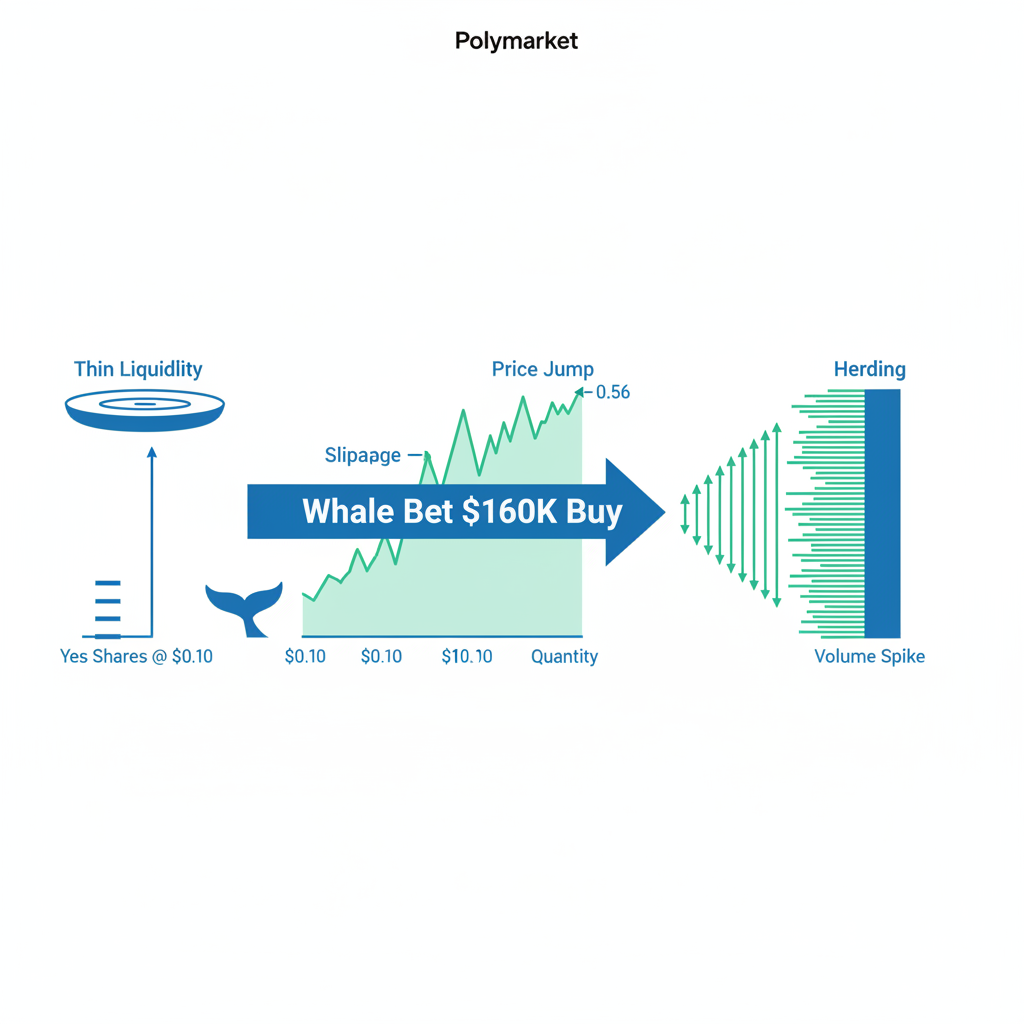
Then psychology hits. Others see the trade on-chain, think "smart money knows something," and pile in. Herding. Remember the 2024 US election? A $50K Trump bet spiked odds several points overnight; copycats pushed it further. Or that $1M climate market flip last year. Whales don't just move prices. They signal sentiment or position ahead of news. Chase blindly? You might buy the top.
The $160K Whale Bet: Timeline of the Ceasefire Odds Surge
Rewind to March 23, 2026. Geopolitical tensions peak. Escalating strikes in the Middle East keep ceasefire odds stuck at 10%. Market volume? Under $200K daily. Sleepy.
Then, wallet 0xA1B2... Lights up. Here's how it unfolded:
- 2:14 PM UTC, March 23: $160K slammed into Yes shares (about 1.6 million at average $0.10).
- Within 30 minutes: Price hits $0.28.
- By 5 PM UTC: $0.42.
- March 24 morning: 56%. Volume explodes to ~$2M.
- Follow-up: Whale adds $20K more; odds hold above 50% despite quiet news.
- By March 26: Dipping to 52% on profit-taking.
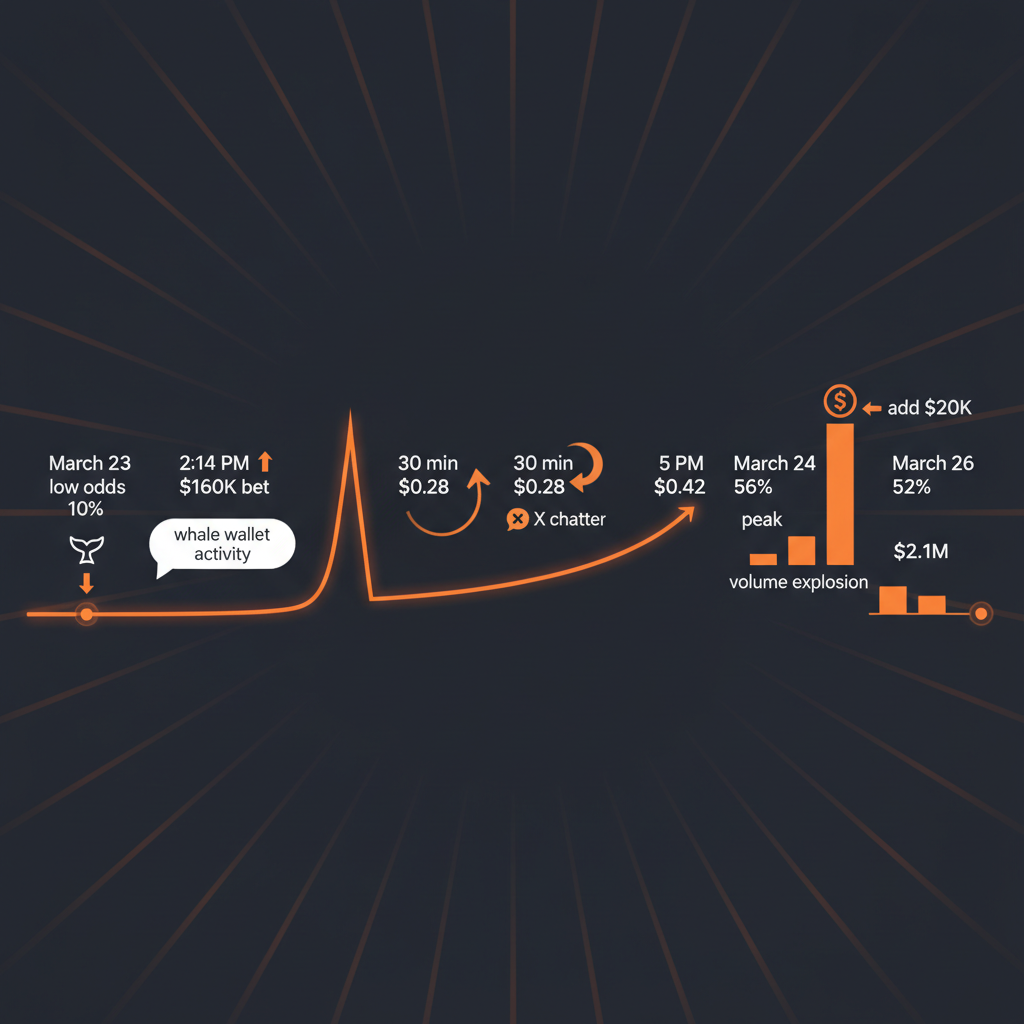
Traders reacted fast. Chat buzzed on X: "Whale alert, insider?" Small bets followed, but the whale held firm. That single bet rewrote the tape.
Polymarket Analysis: Why Did Ceasefire Odds Change So Dramatically?
What sparked this? Not just cash. Timing and thin ice. Pre-bet liquidity was maybe $50K deep. That $160K drained the pool dry, forcing prices up. Basic supply-demand.
Deeper: sentiment flip. Rumors swirled of backchannel talks. Leaked cables hinted at Qatar mediation. Whale likely front-ran it, betting on news. Low liquidity amplified everything. Compare to election markets with $100M+ volume, where $160K barely ripples.
Other signals? Related markets like "Hamas release hostages" ticked up a bit. Not coincidence. Risks? Overreaction. Odds overshot before. Think 2023 Sudan truce bets that crashed on failed talks. This surge screams strategic positioning, but verify with news flows. Whales reflect info edges we retail folks chase.
Who Are the Major Players in Polymarket Trends?
Behind the wallets? A mix. Top geopolitical players include:
- 0xPolyWhale1: Linked to a VC firm, dominates Mideast markets with $5M+ volume.
- 0xGeoKing: Pseudonymous trader with about a 65% hit rate on Ukraine bets last year.
Institutions dip in quietly. Hedge funds like Jane Street test waters via proxies. Retail? Telegram groups and X influencers drive bursts, but whales set tone. Track 'em with Polymarket's explorer, Nansen labels, or Dune's whale dashboards. Spot patterns: this $160K bet matches 0xA1B2's style from a February oil market flip. Know players, read the board better.
How Traders Can Capitalize on Polymarket Predictions and Whale Signals
Ready to play? Monitor big trades first. Set Dune alerts for $50K+ buys, or use Polymarket's API for real-time ticks. Tools like Replicl or custom bots ping you on surges.
Strategies split two ways:
- Momentum: Ride the wave post-whale, sell at around 20% gains like after this bet.
- Contrarian: Fade if volume fades or news contradicts. Odds often revert 10-15% in days.
Risk rules: never bet house money; size at 1-2% portfolio. Volatile? Yes. But edges beat Vegas odds. Pair with news aggregators like Ground News. Test small. Traders have turned $1K into $5K spotting these.
This Polymarket signals event proves prediction markets are a goldmine for savvy traders. Next time odds surge on whale bets, you'll read the probability like a pro, spot trends early, and position for profits. Dive into Polymarket today. Your edge awaits.