
Marco Rubio 2028 Republican Nomination Polymarket Odds Hit 27%: What Changed
Break down the latest Polymarket odds surge for Marco Rubio in 2028 and the trading signals behind the 27% probability.
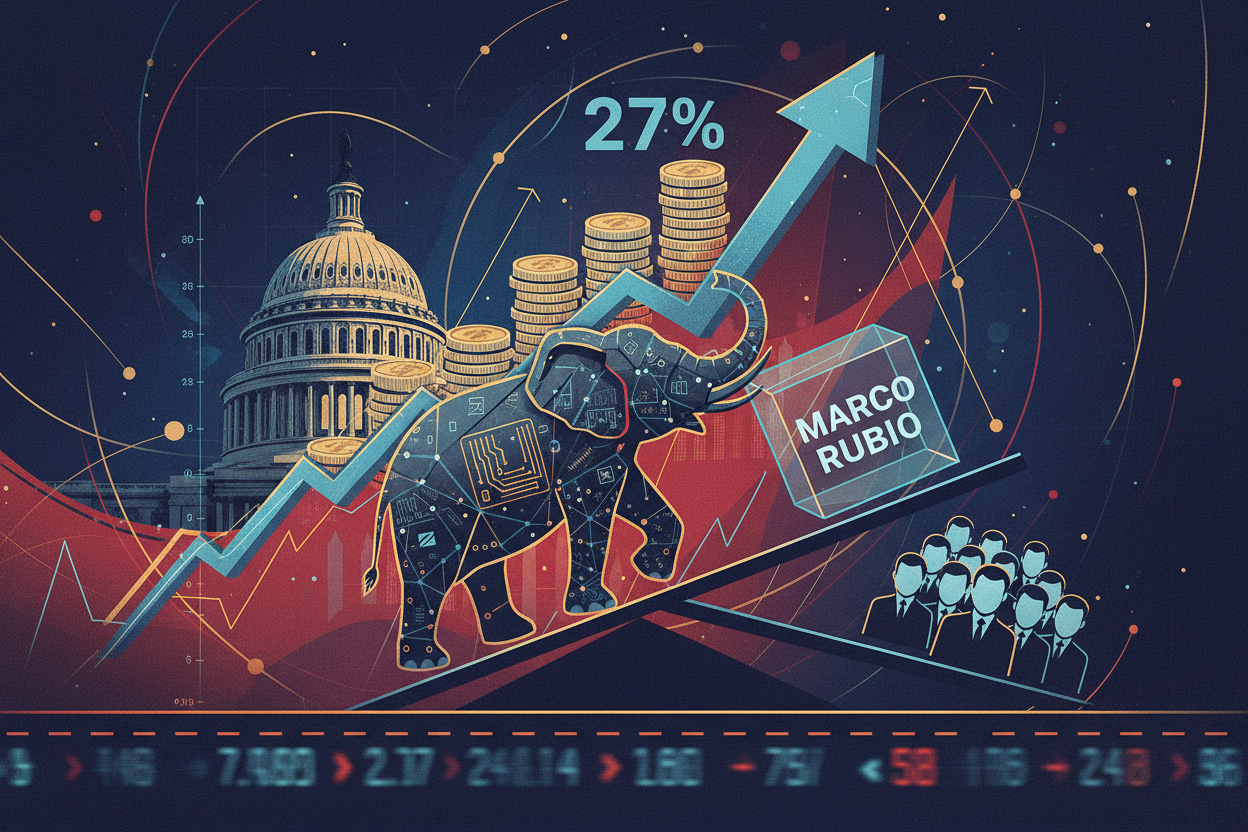
Marco Rubio’s polymarket odds for the 2028 Republican nomination have surged to 27%, but the real story lies in the multi-month repricing across prediction markets driven by specific events. This analysis breaks down the exact catalysts, cross-platform price moves, volume signals, and poll impacts that lifted Rubio from the low teens to a near-front-runner position, giving traders and analysts actionable context for interpreting the 27% figure.
Current Snapshot of Rubio’s Polymarket Odds and Cross-Market Prices
Polymarket currently prices JD Vance at 41% and Marco Rubio at 26% in the Republican Presidential Nominee 2028 market, with $669 million in total volume across presidential contracts. That single-market reading sits close to an aggregated 27.1% probability when traders examine DefiRate’s cross-venue compilation. The same data set shows Rubio at 29.5% on Kalshi, 26.8% on Polymarket, and 36.0% on ForecastEx. Volume and spread differences stand out immediately: Kalshi records only $1.5K in Rubio contracts while Polymarket shows $12.2K, and ForecastEx prints negligible turnover at the 36-cent level.
CNBC’s separate aggregation places Vance near 31% and Rubio just under 27%, confirming the gap between platforms is modest yet consistent. Traders therefore see Rubio’s 26–29% band as the practical consensus rather than an outlier on any one exchange. The 9.2% average spread reported by DefiRate further indicates that liquidity remains adequate for position sizing, even if ForecastEx’s thin book leaves room for wide last-trade prints. These numbers establish the scale of the move without relying on any single venue’s snapshot.
Timeline of Rubio’s Rise on Prediction Market Odds
Rubio’s polymarket odds climbed from roughly 12% to around 30% across recent months on Polymarket, according to the platform’s own event description. The trajectory accelerated in the first half of 2026. On Kalshi the same contract moved from about 12% early in the year to 30% by early June. Over that identical window JD Vance’s Kalshi probability fell from approximately 50% to 33%.
The parallel shifts matter because they show the market reallocating probability rather than simply adding new optimism. Rubio’s gain of roughly 18 percentage points coincided with Vance’s comparable loss, suggesting traders viewed the two candidacies as partial substitutes. Polymarket analysis confirms the broader pattern: the 12-to-30% band reflects sustained buying interest tied to foreign-policy visibility rather than a short-term retail spike. Volume data from the same period shows steady accumulation rather than one-day surges, which helps explain why the new 27% level has held without immediate reversal.
Iran Conflict and Strait of Hormuz Diplomacy as Key Catalysts
- Rubio’s active role in the 2026 Iran conflict produced an immediate lift, pushing his GOP nomination market price on Polymarket to 27% by March 2026.
- The May 8 Strait of Hormuz warning and accompanying viral White House briefing aligned with Rubio trading at 25.4%, accompanied by reports of shadow donor draft activity.
- Rubio’s joint appearance with Vance at the Milan Cortina Winter Olympics opening ceremony moved the presidential-winner contract from 9% to 14%, illustrating how ceremonial visibility can still register on prediction prices.
These discrete events supplied the narrative backbone traders used to update Rubio’s electability. Polymarket commentary links the March 27% print directly to the Iran portfolio, while the Strait of Hormuz episode added media velocity that translated into further bid-side pressure. The Olympics move, though smaller, demonstrated that even non-crisis visibility can compound the earlier gains. Together the catalysts explain why the probability increase persisted across venues instead of fading after each headline cycle.
YouGov Poll Triggers Immediate 18% to 27% Price Jump
A YouGov poll that placed Rubio at 27% support for the 2028 GOP nomination raised his Polymarket price from 18% to 27% the following day. The one-day 9-point move stands out because it occurred without an accompanying change in Vance’s price, isolating the poll as the dominant input. Traders responded by lifting bids into the 26–27-cent range and holding them there, indicating the survey result aligned with preexisting positioning rather than surprising the market entirely.
The speed of repricing also reveals how prediction markets incorporate polling data. Once the YouGov numbers cleared, offers at 18–20 cents disappeared within hours, replaced by a tighter cluster around 26.7–26.9 cents on Polymarket. That clustering has remained stable, suggesting the 27% level now functions as an anchor rather than a temporary overshoot. Subsequent volume has continued to print inside that band, reinforcing the notion that the poll converted latent interest into visible conviction.
Trading Microstructure Signals Confirming Conviction
DefiRate’s aggregation places Rubio at 27.1% implied probability after a 17.3-percentage-point advance, accompanied by $13.8K in total volume and a 9.2% spread. Breaking the figure down by venue shows Polymarket handling the bulk of activity at 26.8% with $12.2K turnover inside a narrow 26.7–26.9-cent band. Kalshi contributes the next largest slice at 29.5% on just $1.5K, while ForecastEx sits at 36% with negligible depth.
Fifteen active Rubio-related markets on Polymarket supply additional liquidity signals. Contracts covering the presidential winner, the GOP nominee, and the vice-presidential slot all trade alongside the headline nomination market. The presence of these parallel books allows traders to hedge or express nuanced views on Rubio’s path, which in turn supports tighter spreads in the primary contract. Sustained volume inside a 2-cent range, rather than wide swings, points to informed accumulation instead of headline-driven noise.
How to Translate 27% Prediction Market Odds Into Betting Terms
Federal News Network converts an 8% probability into +1150 American odds, offering a benchmark for scaling the 27% figure. Rubio at 27% would equate to roughly +270 under the same conversion logic, while smaller probabilities such as Ron DeSantis at 4% map to +2400. These translations help bettors accustomed to sportsbooks interpret prediction-market percentages as implied pricing rather than abstract forecasts.
Remaining risks center on intra-party dynamics and future endorsement flows. Even with current momentum, Rubio’s position depends on sustained donor support and the absence of new entrants who could fragment the field. Traders monitoring the 27% level therefore watch whether volume continues to cluster near 26–27 cents or whether spreads widen again on fresh political developments. The conversion to betting odds simply makes those ongoing adjustments more legible to participants who track traditional lines.
The 27% level reflects measurable repricing from identifiable geopolitical and polling events rather than vague momentum; traders should watch volume and spread tightening on Polymarket and Kalshi for signs of further consolidation or reversal.
Sources
Related Articles

Trinity Tatum Love Island USA Odds Hit 89% on Polymarket Before Finale

Byron Donalds Florida Governor Race Polymarket Odds Reach 92%: What Changed

Regulatory Heat from Brazil and Wisconsin Shakes Polymarket Odds: Risk Analysis