Polymarket Odds on July 2026 Fed Hold at 73%: What the Signals Reveal for Traders
Break down the 73% Polymarket probability for a July Fed hold and learn how prediction market odds shift with dot-plot data and labor market signals.
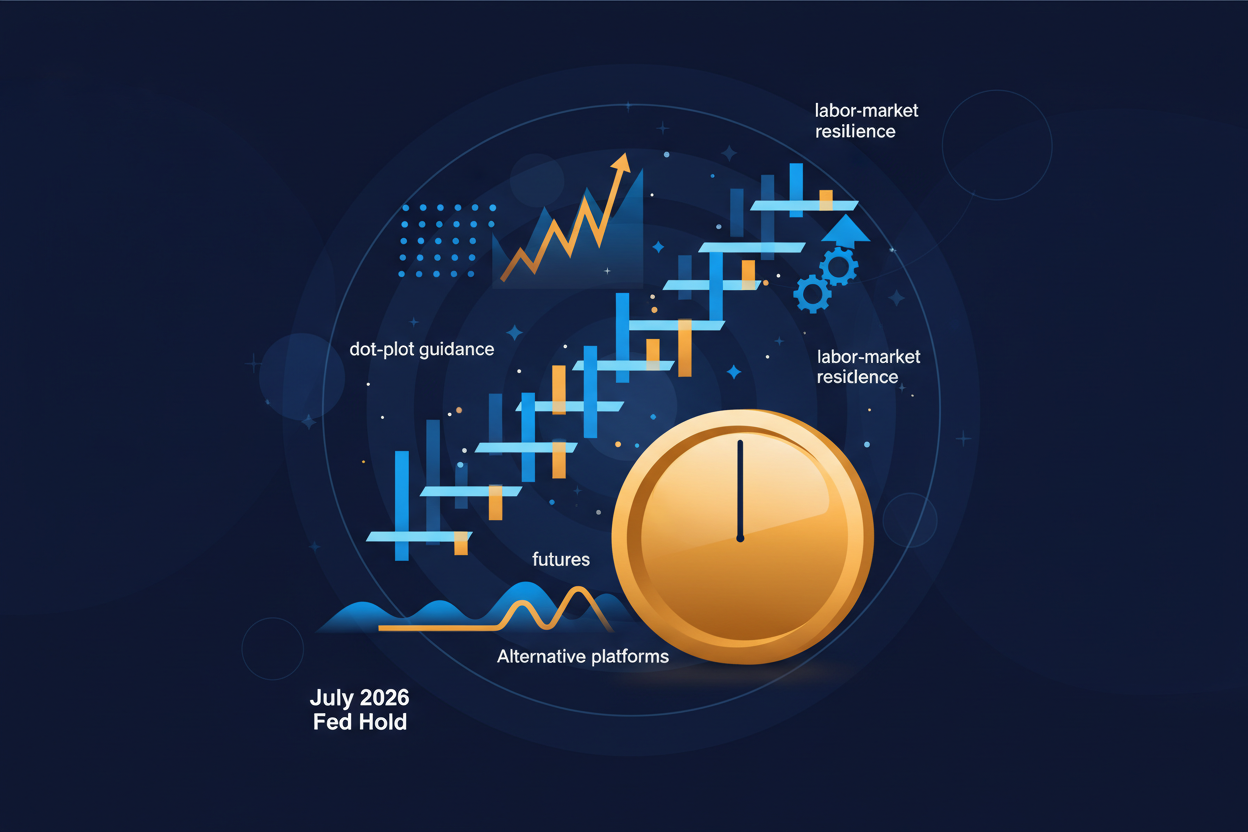
Polymarket odds currently price a 73.3% chance the Fed holds rates steady at the July 29, 2026 FOMC meeting. Prediction market analysis of the July decision shows traders treating these figures as a live indicator rather than a fixed outlook, with polymarket signals updating in real time as fresh data arrives. Understanding how polymarket probability explained works through ladder contracts helps position the odds alongside futures curves and competing platforms.
What Polymarket Odds Are Pricing for the July 2026 Fed Decision
For the Wed Jul 29, 2026 FOMC meeting, Polymarket shows an expected decision of No change with a 77% chance; a 25 bps hike is priced at 22.7%, while 25 bps cuts and 50+ bps hikes or cuts each have probabilities below 1%. In the “Fed Decision in July?” ladder market, the leading “No change” rung is priced at Yes 73.3% / No 26.7%, with “25 bps increase” at Yes 25.1% and “50+ bps increase” at Yes 0.7%; total volume is reported at approximately $87,609,151. Frontierbeat cites Polymarket pricing a July hold at 83.5% and a 25-basis-point increase at 15.8%, with more than $81 million in volume; it notes the no-change probability fell from about 92% to 83.5% after hotter inflation data and hawkish Fed commentary. These snapshots arrive from slightly different moments, so the headline number drifts as order flow arrives. Volume above $80 million across the July decision contracts confirms meaningful capital has already voted on the outcome. Because each contract settles on the actual FOMC announcement, the market must keep repricing whenever labor prints or inflation releases shift expectations. The result is a probability that functions more like a continuous poll than a one-time forecast.
How Ladder Markets Convert Prices into Probabilities
Polymarket structures the July decision as a set of independent yes/no contracts, one for each possible rate move. Polymarket explains that if “Yes” shares in the “Fed rate hike in 2026?” market are priced at 48¢, the market collectively assigns a 48% chance that at least one hike will occur; prices update in real time based on trades. When a trader buys the “No change” contract at 73 cents, the purchase itself nudges the displayed probability higher until a seller appears. Because every rung carries its own order book, the full ladder reveals where the crowd sees the marginal risk. This mechanical link lets participants read crowd sentiment straight from the quote screen rather than waiting for after-the-fact surveys.
Recent Swings in Polymarket July Hold Odds and Their Macro Drivers
- Following the June FOMC decision that kept the federal funds rate at 3.50%–3.75%, the Polymarket event page reported market-implied odds heavily favoring No change at 79.5%, with a 19.4% price for a 25 bps hike and negligible probabilities for cuts.
- Polymarket’s historical summary shows the “No change” probability ticking up +1.8 percentage points from 71.5% to 73.3% on large cumulative volume, but also records a −10.0 percentage point change over both 24 hours and 7 days, with a reversal_detected flag indicating choppy trading.
- Frontierbeat cites Polymarket pricing a July hold at 83.5% and a 25-basis-point increase at 15.8%, with more than $81 million in volume; it notes the no-change probability fell from about 92% to 83.5% after hotter inflation data and hawkish Fed commentary.
Each of these moves traced directly to incoming macro prints or official remarks. The initial drop from the low-90s range followed hotter-than-expected CPI and subsequent comments from Fed officials. Later stabilization near current levels reflected resilient labor data that reduced the immediate need for easing. Because the contracts trade continuously, any single release can shift the entire ladder within minutes.
Polymarket Odds Compared with Fed Funds Futures and Kalshi
Frontierbeat reports that institutional macro desks saw Fed funds futures pricing roughly a 70% probability of a July hold, compared with Polymarket odds “closer to 84%,” indicating a divergence between prediction market and futures-based expectations. PolyVeritas notes that Polymarket’s 78.5% no-change probability for July is higher than Kalshi’s 54% odds of at least one rate hike by year-end, suggesting traders see July as too early for a move despite expecting some tightening later. The gap arises partly because prediction markets draw a broader retail and crypto-native audience that may weight certain data points differently from bank macro desks. Futures prices embed balance-sheet and margin considerations that prediction platforms do not. When the two sets of odds diverge by more than 10 points, traders often look for the next data release that will pull one side toward the other.
How Traders Can Use Polymarket Fed Markets for Positioning
- In the Polymarket market “Fed decisions (Apr, Jul),” the leading outcome “Pause, Pause, Pause”, no change in April, June, and July, trades at 91%, with “Other” at 9%; earlier commentary references a 79% implied probability for that sequence driven by sticky inflation and a hawkish policy tilt.
- In the Polymarket “Fed rate hike in 2026?” market, the current crowd‑sourced probability is 48% for “Yes”, meaning traders collectively assign a 48% chance of at least one Fed rate hike during 2026.
- In Polymarket’s “Fed rate cut by…?” market, July is assigned only 1% probability as the meeting for the next rate cut; the leading outcome is “December Meeting” at 20%, followed by “October Meeting” at 14%.
Traders size hedges by watching how these separate contracts reprice relative to one another. A sudden lift in the July hold contract can signal reduced near-term volatility and justify carrying longer duration. Monitoring the full set of rungs gives a path-dependent view rather than a single binary bet.
Key Risks When Trading on Prediction Market Signals
Participation remains thinner than Treasury futures. Traders therefore treat the ladder as one input among several rather than a standalone signal.
Current Polymarket July 2026 hold levels are best viewed as a dynamic sentiment gauge that updates faster than many traditional models; monitor the ladder rungs, cross-check against futures, and size positions only after confirming the probability move aligns with incoming macro data.
Sources
- Polymarket, Federal Reserve rates dashboard
- Blockchain.news, “Polymarket sees 73% odds of July Fed hold as volatility stays high”
- Polymarket, “Fed Decision in July? Trading Odds & Predictions 2026”
- Polymarket, “Fed Rates Odds & Predictions 2026”
- Polymarket, “Fed Predictions & Real-Time Odds”
- PolyVeritas, “Fed July 2026: No Change Likely Despite Rate Hike Fears”
- Frontierbeat, “How Prediction Markets Are Pricing the Federal Reserve’s July 2026 Rate Move”
- Polymarket, “Fed rate hike in 2026? Trading Odds & Predictions”
- Polymarket, “Fed decisions (Apr, Jul) Trading Odds & Predictions 2026”
- Polymarket, “Fed rate cut by…? Predictions & Odds 2026”