
TypeScript CLI Tool Parses Live Feeds to Detect Polymarket Signals
See how the new TypeScript CLI detects spikes and drawdowns in real time to generate actionable polymarket signals for crypto prediction markets.

What Is the TypeScript CLI Tool for Polymarket Signals?
Traders chasing an edge in crypto prediction markets often miss timely polymarket signals because most dashboards update too slowly. TypeScript-based tools can help parse live feeds, turning raw data into actionable alerts before the market moves.
Polymarket sees substantial trading volume across hundreds of markets. That scale creates constant streams of order flow and price movement that static web interfaces often lag behind. TypeScript approaches were built specifically to close that gap. They connect directly to live data sources and surface changes in volume, price, and order activity as they occur.
Developers use the official TypeScript client real-time-data-client for the RTDS. The official Polymarket CLI written in Rust focuses on browsing markets, placing trades, managing positions, and interacting with on-chain contracts.
How the CLI Integrates with Polymarket APIs
Polymarket exposes three main APIs, Gamma API, Data API, and CLOB API, that together supply market data, user positions, trades, and order book information. TypeScript tools use these endpoints to build a continuous data pipeline. They authenticate through standard API keys and then open persistent WebSocket connections to the Real-Time Data Socket at wss://ws-live-data.polymarket.com.
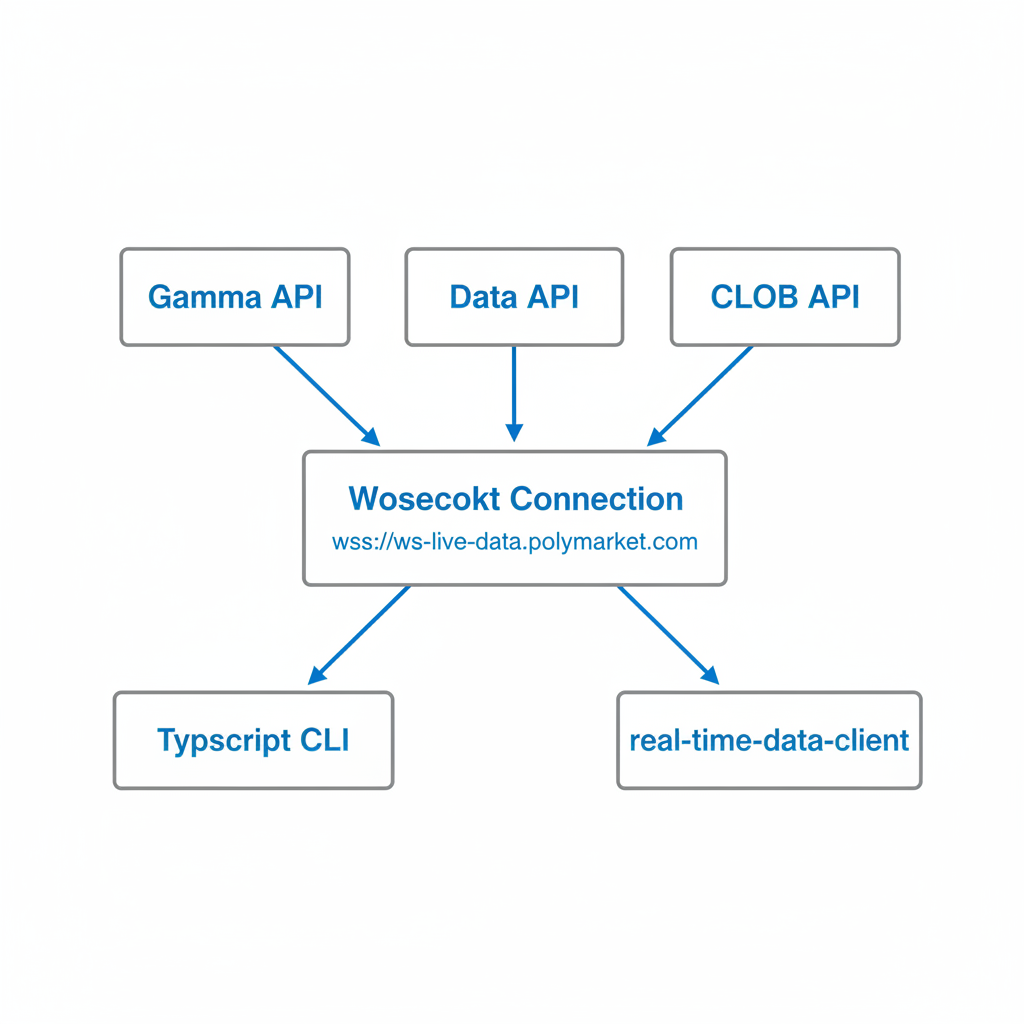
The official TypeScript client for this socket, real-time-data-client, forms the foundation for the connection layer. Once connected, the tools efficiently parse order book updates and trade events. The architecture keeps memory usage low, which matters when monitoring dozens of markets simultaneously.
Developers can also layer the Struct API on top of the same connection. Struct.to supplies real-time data for events, markets, positions, and traders, allowing cross-reference of order flow with position changes in a single stream. This combination produces a unified feed that arrives faster than polling-based approaches.
Key Features That Surface Polymarket Trends
TypeScript tools built with the Polys toolkit can be extended for signal detection. The Polys toolkit supplies type-safe, modular components and built-in order attribution. The modular design makes it straightforward to add new detection rules without forking the core codebase.
Real-time alerts run directly in the terminal or route to external services through simple webhook payloads. Export options let traders save detected events to CSV or JSON for later analysis or backtesting. These features rest on the Polys toolkit, which supplies type-safe, modular components and built-in order attribution. The modular design makes it straightforward to add new detection rules without forking the core codebase.
Because the tools stay in memory and maintain open sockets, they avoid the refresh cycles that affect web dashboards. Alerts can provide timely notice of an order book change or trade execution, giving users earlier notice of emerging trends.
How Traders Use the Tool to Detect Prediction Market Signals
A trader monitoring a specific election contract can start the CLI with a single command that subscribes to that market’s order book and trade stream. When sudden volume arrives or the mid-price shifts beyond the configured threshold, the tool prints the event details and optionally posts to a webhook. Repeating the pattern across several related markets produces a lightweight dashboard in the terminal itself.

Users frequently combine multiple signals. One rule might watch for large incoming orders on one side of the book, while another tracks changes in open interest from the Struct API. When both conditions align, the CLI can trigger a stronger alert or log the coincidence for later review.
Common workflows include a command that loads a configuration file listing ten markets and their individual thresholds, another that pipes alerts into a local database for historical comparison, and a third that combines the TypeScript output with the Rust-based Polymarket CLI so detected signals can immediately feed into order placement scripts. These patterns run locally with no external service dependencies beyond the Polymarket endpoints.
Take a closer look at one workflow. Say you want to track three related markets on an upcoming vote. You drop their market IDs into a simple JSON config, set volume thresholds that feel right for each one, and run the CLI. It spins up the connections, watches the streams, and only speaks up when something actually moves. No constant screen staring required. If you later decide the alerts need more context, like pulling in recent trade sizes, you edit one function and restart. The whole thing stays on your machine.
Another angle people like is piping the output straight into a small script that colors the terminal based on signal strength. Green for volume spikes that match your rules, yellow for price drifts that stay within bounds. It turns the CLI into something you can glance at while working on other tasks. Over time you start noticing patterns in how certain markets behave right before bigger moves, and those observations feed back into tighter rules.
Benefits Over Other Crypto Prediction Market Tools
Most web dashboards introduce latency through polling intervals and page rendering. TypeScript tools maintain persistent WebSocket connections, so they register updates as soon as Polymarket publishes them. This difference becomes noticeable during high-activity periods when order book depth changes rapidly.
Full control comes from the code itself. Traders can inspect, modify, or extend detection logic without waiting for vendor updates. The Polys toolkit’s emphasis on developer experience further reduces the time required to add custom rules or integrate additional data sources.
There are no subscription fees or usage limits. The project runs on the user’s machine and connects only to public Polymarket endpoints and the official real-time-data-client. This removes concerns about rate caps that sometimes affect hosted analytics services.
Traders sometimes keep such tools running on a spare machine that only handles alerts. When something fires, a simple script forwards the message to their phone. It is not fancy, but it works without adding another monthly bill or another browser tab. The same setup lets them test new detection ideas on weekends without touching their main trading machine.
Equipped with TypeScript tools, you can now parse live feeds and detect polymarket signals faster than ever, giving you a clearer view of crypto prediction markets. The real question is which signals you decide to act on once they start showing up in your terminal.